7-Nights A Week in... The Amalfi Coast, Capri & Rome - Land Journey from $9,590
Tauck
OFFER ID 1632704
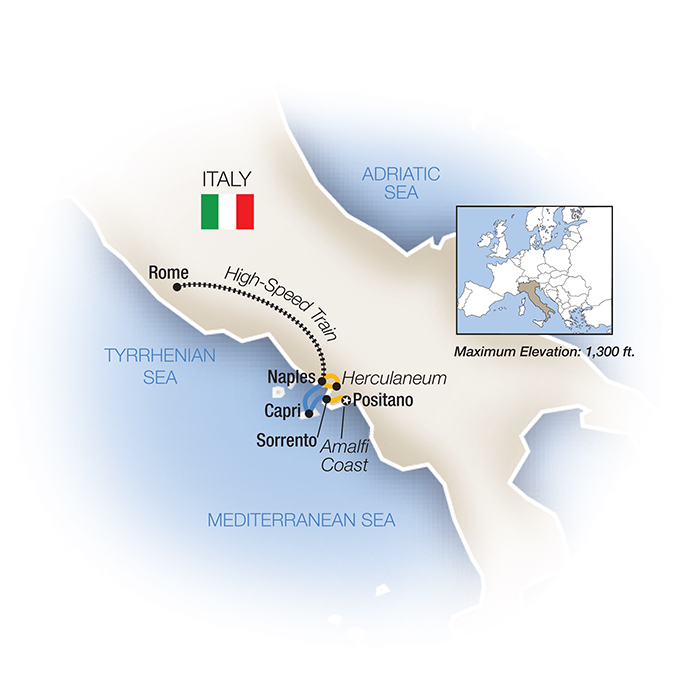
Celebrities have long flocked to places like Rome, Capri and the Amalfi Coast for the scenery, the history, the culture and the warm welcomes that await them wherever they go. Explore the storied history and cultural treasures of the Vatican, as well as Rome's Imperial and Renaissance treasures... architectural landmarks combining with the natural beauty of the Isle of Capri's rugged coastline, and the seaside villages and cliffs found along the Amalfi Coast... Enjoy the star treatment yourself as you... gather eternal memories of Roman landmarks during a three-night stay, highlighted by a guided visit to the Vatican Museums and Sistine Chapel... speed by jet boat to Capri where your chauffeured convertible car will show you the movie-set sights of this island of amore... are wowed with with the sights of Positano... travel to a clifftop villa and popular eatery in Ravello for a taste of life along the Amalfi Coast... meander through the storytelling ruins of Herculaneum...
7 nights from $9,590 per person
Itinerary Details
Day 1 Positano, Italy
Arrive Naples / Positano
Tour begins: 6:00 PM, Le Agavi Hotel, Positano. A transfer is included from Naples Airport to Le Agavi Hotel in Positano, built into a cliff overlooking the bay. Join us for a welcome reception and dinner tonight at the hotel amidst stunning views.
Meals: D
Day 2 Ravello, Italy
A Taste of Life in Amalfi & Ravello
Drive along the Amalfi Coast, one of Europe's most dramatic shorelines. See the brightly colored houses set on towering cliffs above the sea, and the houses in the town of Amalfi built between the 10th and 13th centuries. Then it's on to Ravello to visit the exquisite gardens of Villa Rufolo, the former residence of several popes, offering perhaps the best view on the coast. Lunch today is at a family-owned restaurant overlooking the Gulf of Salerno - a favorite of locals and celebrities alike - where you'll get a real taste of Italy with delightful homemade dishes. Return to Positano, and enjoy the afternoon and evening as you please.
Meals: B, L
Day 3 Capri, Italy
Ferry ride to the Isle of Capri
Ride aboard a high-speed ferryboat to the Isle of Capri, once a second home to Europe's emperors and today a favorite destination for celebrities and jet setters. Travel by convertible taxi to one of the most celebrated hotels in Europe, set on exclusive Via Camerelle in the heart of Capri. After lunch, the rest of the day is at your leisure.
Meals: B, L, D
Day 4 Anacapri, Italy
Capri by private convertible car
You'll really feel like a jet setter today when you explore the history and natural attractions of the Isle of Capri in a convertible car. Visit the town of Anacapri, then beautiful Villa San Michele, built in the late 19th century atop Roman palace ruins. The views of Capri and its harbor are stunning - and you'll have an opportunity to enjoy them from the water on a cruise around the island. Then spend the rest of the day as you please on Capri - enjoying the pleasures of a less-crowded island after the day-trippers have departed.
Meals: B
Day 5 Rome, Italy
Herculaneum & on to Rome
Depart Capri by high-speed ferryboat this morning to Naples - capital of the Campania region and one of Italy's most important cities. Board a coach to Herculaneum for a guided tour of the archaeological site. What was once an affluent Roman resort town was buried in volcanic ash by the same eruption of Mount Vesuvius that destroyed the nearby city of Pompeii in 79 AD. As you'll see during your visit, studies of Herculaneum's remains have enabled archaeologists to create a picture of daily life in the Roman Empire in the 1st century. Travel by high-speed train from Naples to Rome, to conclude your trip with a three-night stay at a historic hotel in the heart of the city.
Meals: B
Day 6 Rome, Italy
Rome's piazzas & the city as you please
Today's city sightseeing begins with a guided walking tour of Rome's magnificent piazzas - including the Piazza di Spagna, the Piazza del Pantheon and the Piazza Navona, featuring the famous Fontana dei Quattro Fiumi (Fountain of the Four Rivers), created by the 17th-century Italian sculptor and architect Gian Lorenzo Bernini. After lunch at a local restaurant, you have an opportunity to join us for additional sightseeing in Rome; alternatively, the remainder of the day is free to spend time exploring Rome as you please.
Meals: B, L
Day 7 Rome, Italy
Vatican City and a free afternoon in Rome
Begin the day with a guided visit through the Vatican Museums, a remarkable collection spanning centuries of art, history, and devotion. Your guide leads you through galleries of classical sculpture, Renaissance masterworks, and treasures gathered by generations of popes. The experience culminates in Michelangelo's Sistine Chapel, where the ceiling frescoes and Last Judgment reveal the artist's genius on a monumental scale. From there, step into Rome's magnificent St. Peter's Square, designed in the seventeenth century by Bernini with its perfectly symmetrical, elliptical colonnades defining one of the world's great architectural spaces. Continue inside St. Peter's Basilica - the largest Christian church in the world - where your guide introduces Bernini's soaring canopy and Michelangelo's Pietà. The afternoon is free to explore more of Rome on your own before gathering this evening for a farewell reception and dinner.
Meals: B, D
Day 8 Rome, Italy
Journey Home
Tours ends: Rome. Fly home anytime. A transfer is included from Aleph Rome Hotel, Curio Collection by Hilton to Leonardo da Vinci Airport in Fiumicino or Ciampino Airport in Rome. Please allow 3 hours for flight check-in.
Meals: B
Sprawled across seven legendary hills, romantic and beautiful Rome was one
of the great centers of the ancient world. Although its beginning is shrouded
in legend and its development is full of intrigue and struggle, Rome has always
been and remains the Eternal City.
Rome enjoyed its greatest splendor during the 1st and 2nd centuries when art
flourished, monumental works of architecture were erected, and the mighty Roman
legions swept outward, conquering all of Italy. These victorious armies then
swept across the Mediterranean and beyond to conquer most of the known world.
With Rome's establishment as capital of the western world, a new ascent to glory
began.
Today's Rome, with its splendid churches, ancient monuments and palaces, spacious
parks, tree-lined boulevards, fountains, outdoor cafes and elegant shops, is
one of the world’s most attractive and exciting cities. Among the most famous
monuments is the Colosseum. As you walk its cool, dark passageways, imagine
the voices that once filled the arena as 50,000 spectators watched combats between
muscled gladiators and ferocious animals.
Stop to see the remains of the Forum, once the city's political and commercial
center. In later times, Rome's squares were enhanced with such imposing structures
as the Vittorio Emanuele Monument and grandiose fountains like the Fontana di
Trevi. Join the millions who stand in awe of Christendom’s most magnificent
church and admire the timeless masterpieces of Michelangelo's frescoes in the
Sistine Chapel.
Rome jars the senses and captures the soul. Grasp all you can during the short,
precious time you have available in the Eternal City. With so much to see and
do, a day or two will only allow you a sampling of the city's marvelous treasures.
Caution: As in many big cities and tourist destinations purse snatching
and pickpocketing is common. Valuable jewelry and excess cash are best left
in a safety deposit box in your hotel.
Shopping For most visitors shopping for beautiful Italian leather articles,
designer shoes, fashions for men and women, linens, knitwear, silk scarves and
ties is a favorite pastime. Except for tourist-oriented shops, the majority
of stores are closed on Sundays. Some of the department stores, such as Rinascente,
open in the late afternoon on Sundays.
Cuisine Rome's choice of restaurants is mindboggling as is the variety
of cuisine. Whether your meal is at a top-rated restaurant or a rustic trattoria,
you can be sure that you will enjoy your food, especially when accompanied by
wines from the hill towns surrounding Rome.
Other Sights Rome's attractions are endless, and depending on how much
time you have at your disposal a careful selection has to be made about what
to see. Be aware of horrendous traffic conditions and major construction work
all around the city in preparation of Jubilee 2000, the Holy Year. Some of the
sights not to be missed:
Piazza Venezia - This busy square is easily recognized by its imposing Vittorio
Emanuele II Monument. The white marble structure was inaugurated in 1911 as
a symbol of Italy’s unification.
The Forum - Once the civic heart of ancient Rome, today the remains include
a series of ruins, marble fragments, isolated columns and some worn arches.
Colosseum - No visit to Rome is complete without a stop at this awe-inspiring
theater, which is among the world’s most celebrated buildings. Here ancient
Rome flocked to see gladiatorial contests and numerous other spectacles.
Trevi Fountain - Take a stroll to Rome's famous fountain. A spectacular fantasy
of mythical sea creatures and cascades of splashing water, the fountain is one
of the city's foremost attractions. Legend has it that visitors must toss a
coin into the fountain to ensure their return to Rome.
St. Peter's Square - Part of Vatican City, this square created by Bernini
is considered one of the loveliest squares in the world. Twin Doric colonnades
topped with statues of various saints and martyrs flank either side of the square.
In the center stands an 84-foot obelisk, brought from Egypt in 37 A.D.
St. Peter's Basilica - At the head of the square stands Christendom's most
magnificent church, which was begun in 1452 on the site where St. Peter was
buried. Throughout the following 200 years, such Renaissance masters as Bramante,
Michelangelo, Raphael and Bernini worked on its design and created an unparalleled
masterpiece. Of special note are Michelangelo's Pieta and the bronze canopy
over the high altar by Bernini. The immense dome was designed by Michelangelo.
Vatican Museum - To see this museum's immense collection would take days.
As you enter, there are special posters that plot a choice of four color-coded
itineraries. They are repeated throughout the museum and are easy to follow.
It is a good idea to pickup a leaflet at the main entrance and concentrate on
exhibits of major interest. Of course, the Sistine Chapel is a must. Most likely
you may have to wait in line to enter.
Excursions
Rome Highlights and Vatican: 9 hours
Rome Highlights and Vatican: 9 hours
Meet your private English-speaking driver at the pier side of Civitavecchia port.
Rome is a mix of architecture styles, of antiques and new, of sacred and profane. In this full day tour you can enjoy a sample of this capital city. With your guide reach the Vatican city where you can visit the Museums, admiring its priceless collection of art and architecture: highlights include Raphael's Transfiguration, The Raphael Rooms, the Sculpture Garden featuring the famous Laokoon. Finally, the restored Sistine Chapel, famous all over the world for the breathtaking Michelangelo’s ceiling and the Last Judgment. From here you walk to St. Peter's Basilica to marvel at Michelangelo's Dome, his statue Pietà, Bernini's magnificent Baldacchino and the Tombs of the Popes. The tour will continue with a look at the ancient part of the Eternal city and its symbol: the Coliseum, where, jumping the lines, you will be able to enter in the magnificent Flavian Amphitheatre and admire where the gladiatorial duels, wild beast fights were arranged for the entertainment of Roman people.
The second part of the day will be dedicated to the visit of the city center, starting from Navona Square, the most important of Baroque Rome, where today it is possible to admire the monumental Fountain of the Rivers by Bernini. Continue your tour visiting the Pantheon, the jewel of Roman architecture, then Trevi Fountain, the most famous and beautiful fountain in Rome. End the tour at the Spanish Steps, built entirely in travertine in the 18th century.
We will ensure your timely return transfer to the Civitavecchia Port
Access to the Vatican Museums and St. Peter's Basilica is allowed only to properly attired visitors.
Highlights:
- Vatican Museums, Ancient Rome, main highlights
Tour can Operate: Morning
Wheelchair Accessible: Yes
Physical Activity Level: low
Inclusions:
· Luxury Mercedes minivan at disposal for the entire day
· English-speaking driver at disposal for the entire day
· 6 hour private English-speaking guide
· No Line entrance fees for the Vatican Museums and Colosseum
Exclusions:
· All cruise travel, personal items, meals and associated costs
· Gratuities
Tivoli: Villas in the Countryside - 8 Hours
Tivoli: Villas in the Countryside - 8 Hours
A trip out to Tivoli, just east of Rome, makes for a perfect and relaxing day, when you need a little rest from extensive sightseeing in the city. On your way out, you will pass the Travertine marble quarries from which so many of Rome’s important buildings were constructed. Tivoli itself is a very pleasant town, perched on a hill but its main claim to fame lies in its country villas, Hadrian’s Villa and the Villa d’Este. The emperor Hadrian was very well traveled and when he decided to build a country villa, he was greatly influenced by some of the spectacular sights he’d seen on his travels. The result was probably the largest and most sumptuous villa in the Roman Empire and by any standards, it is huge and covers an area that would normally be occupied by a small town. The site became a sort of retirement home for Hadrian, from 135AD until his death three years later. Here you will see the remains of peaceful and romantic gardens, pools, a theater and baths, which were of course an essential part of any Roman villa. From here, you will visit the stunning Villa d’Este, built for Cardinal Ippolito d’Este in the mid-16th century. Its gardens and fountains are legendery but the restored ground floor apartments have some stunning frescoes.
Duration: 8 hours
Pricing: Please Inquire
Ostia Antica - 6 Hours
If you can’t fit in a trip to Pompeii, Ostia Antica makes a very worthwhile substitute and even though it is right by the airport, it is largely overlooked by the majority of tourists and never suffers from crowds. Ostia Antica was the main port for the city of Rome and consequently, where goods from all over the Empire were unloaded. You will see warehouses, high rise apartments for the workers and sumptuous villas for the nobility as well as baths complete with mosaics and the odd bar or two. Even the public lavatories have survived! Just outside the town, lies the beautiful castle of Pope Julius II, largely built from recycled bricks from Ostia Antica.
After the visit of the archaeological site, driving back towards the port, you will have the chance to stop for lunch in a great fish restaurant overlooking the sea.
Duration: 6 hours
Pricing: Please Inquire
Roman Castles - 8 Hours
The Castelli Romani (Roman castles) are a mere 35 minutes from Rome, but you could be hours away. Beautiful green hills, topped with ancient towns, a couple of volcanic lakes, delicious cuisine and abundant wines, the most famous being Frascati; all explain why Romans have been building their summer villas here for centuries. The most famous of these being Castel Gandolfo, the summer residence of the Pope. Frascati is the largest of these towns, while Nemi, the smallest gives its name to one of the lakes. The route out of Rome is worthwhile too, as you will pass the remains of the aqueducts that once carried water into the city and other imposing ruins.
Duration: 8 hours
Pricing: Please Inquire
Lake Bracciano and the Monster Park - 8 Hours
Lake Bracciano and the Monster Park - 8 Hours
You will start the day by being driven to Lake Bracciano, a delightful spot and much favored by Romans escaping from the heat of the city by having a refreshing swim in the lake. It burst onto the world stage in 2006, when Tom Cruise and Katie Holmes got married in the local castle.
After a stroll around the town, you will be taken to Viterbo where at nearby Bomarzo is a most extraordinary garden, known as the Parco dei Mostri, the Monster Park. This makes a great day out for children. Created by the hunchbacked Duke of Orsini in 1552, he set out to mock the Mannerist gardens of the time by deliberate vulgarity. At the entrance to the park stands a giant warrior, tearing apart a woodcutter, while deeper into the park, you will come across an English prince pouring the brains of a madman down an elephant’s trunk. The surprises continue to come; mossy sculptures of tortoises, elephants, a whale, dragons, nymphs and butterflies, to name but a few. After Orsini’s death, the park became very neglected but has now been restored to its former glory.
Duration: 8 hours
Pricing: Please Inquire
Laid at the southern feet of the Mounts Lattari, which protect it from the
Northwinds, Positano enjoys - thanks to its favourable position - all the advantages
of a mild, dry climate. It is surrounded by green mounts, which form a sort
of crown: Mount Comune, Mt. S. Maria del Castello, Mt. S. Angelo a Tre Pizzi
(1444 metres high), Mt. Conocchia, Mt. Campo dei Galli and Mt. Paipo; towards
south and east the gaze sweeps over the sea up to Punta Licosa and Capri. Three
miles away from the coast a little arcipelago rises from the sea - "Li Galli"
or "Sirenuse" - composed by three islands: "Gallo Lungo", "Rotonda", "Castelluccio",
which was always supposed to be the abode of the bewitching Syrians.
The origins of Positano, like those of many other towns, are lost in the mists
of time, so that it is difficult to distinguish between history and legend.
As it often happen in the past, myths supplied for the lack of data: one of
these myths tells us that Positano was founded by Poseidon - the Latin Neptune,
the god of the sea - for the sake of the nymph Pasitea, whom he loved. It is
certain that Phoenicians and Greeks, travelling westwards, landed in Positano,
which at that time, was inhabited by Oschi and Piceni. The Romans built near
the 'great' beach a rich patrician villa, which has now been buried by gardens
and by the church devoted to Our Lady of the Assumption. With the fall of the
Roman Empire Positano became a part of the Republic of Amalfi, the first maritime
republic, and went through flourishing period, owing to the commerce with the
other countries of the Mediterranean area.
Unfortunately this period was followed by gloomy ones, particularly during
the Angevin and Aragonese domination, when our village was more than once exposed
to the offence of the Saracen pirates, first, and, then of the Turkmen. A legend
referring to that period says that the Saracen pirates, during an incursion,
sacked the main Church and brought away, among other things, the Byzantine picture
of Black Virgin, which was kept in the church and is now to be found in the
apse over the high altar; they had just left the shore, when a voice was heard,
that said: "Posa, posa". The pirates became aware of having committed a sacrilege,
repented came back ashore and restored all the ill-gotten goods. To defend themselves
from the very frequent raids of the pirates the inhabitants of Positano built
three guard-towers, which can still be seen today in the quarters called "Fornillo",
"La Trasita", "La Sponda" and some others in the inner part of the village.
In the same period the mountain villages of Montepertuso and Nocelle enlarged
to harbour the inhabitants of Positano and Laurito, who feared the pirates.
In 1700 there was a thriving period as it is shown by many villas in the late
Baroque style, built on the East coast. The Unification of Italy forced many
inhabitants of Positano, as it happened for so many other people of South Italy,
to migrate to America, where fortune smiled on some of them. After the First
World War - during which Positano also paid its great tribute of blood - this
village, which was already the refuge of some Italian artists, like Vincenzo
Caprile, harboured many Russian, German artists and men of letters, who chose
it for its peace and quiet. Among others we can remember: Semenov, Zagoruiko,
Essad Bey, Clavel, Escher, Massine, Kovaliska, Ghillausen, etc., who with their
works maid this flat of land known all over the world.
The tourism booming took place after the Second World War; but despite of an
intense expansion our village preserve its characteristic vertical structure
and its bright architecture with suggestive, panoramique corners. Thanks to
the innate sense of hospitality of its inhabitants Positano became one of the
most famous tourist places all over the world. Our village is also internationally
known for its clothing production: many little, but elegant boutiques, which
are almost everywhere on both sides of streets and lanes, can satisfy all the
requests of a cosmopolitan clientele. Its favourable position put it in the
centre of a land rich of history and natural beauties. During the summer a series
of patronal feasts - among which we can remember that on the 2nd of July in
Montepertuso and that on the 15th of August in Positano - and cultural events
- like the International Award for the Art of Dancing to the memory of the great
dancer-choreographer Leonide Massine - gladden the evenings, making the stay
in this charming place, also called the "Gem of the divine coast", more pleasant
and suggestive.
Vacation Details
* This departure has been designated a guaranteed departure by the operator, meaning that the minimum number of guests has been met, although still subject to weather and other conditions.
All fares are quoted in US Dollars.
Reference this number when contacting our agency so we may better serve you. Also keeping this number handy will allow you to locate this document again quickly.